

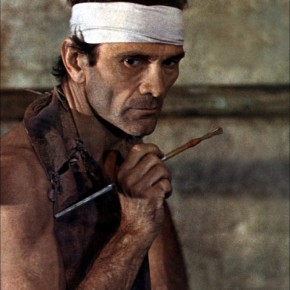
In November last year, a dismal jubilee was celebrated; the 40th anniversary of the murder of the Italian filmmaker and writer Pier Paolo Pasolini.
Setting out from Ilias Papailiakis’ Studies on Pasolini’s portrait, 2015, a presentation of Pasolini is unfolded by Lars Gustaf Andersson, who in 1992 published The Children of Angels, a study on Pasolini’s filmmaking. The universe of Pasolini – his art and his political position – is based on the idea of the material and bodily language as a shield against the consumerism and conformism that during the post-war era succeeded in implementing the fascist homogenisation of the human being that Mussolini failed to accomplish. Pasolini spoke of the new fascism as “The Power without a Face” and against this he juxtaposed the real faces of real humans. With Papailiakis’ pencil portrait of the murdered Pasolini, another face is added to this row.